





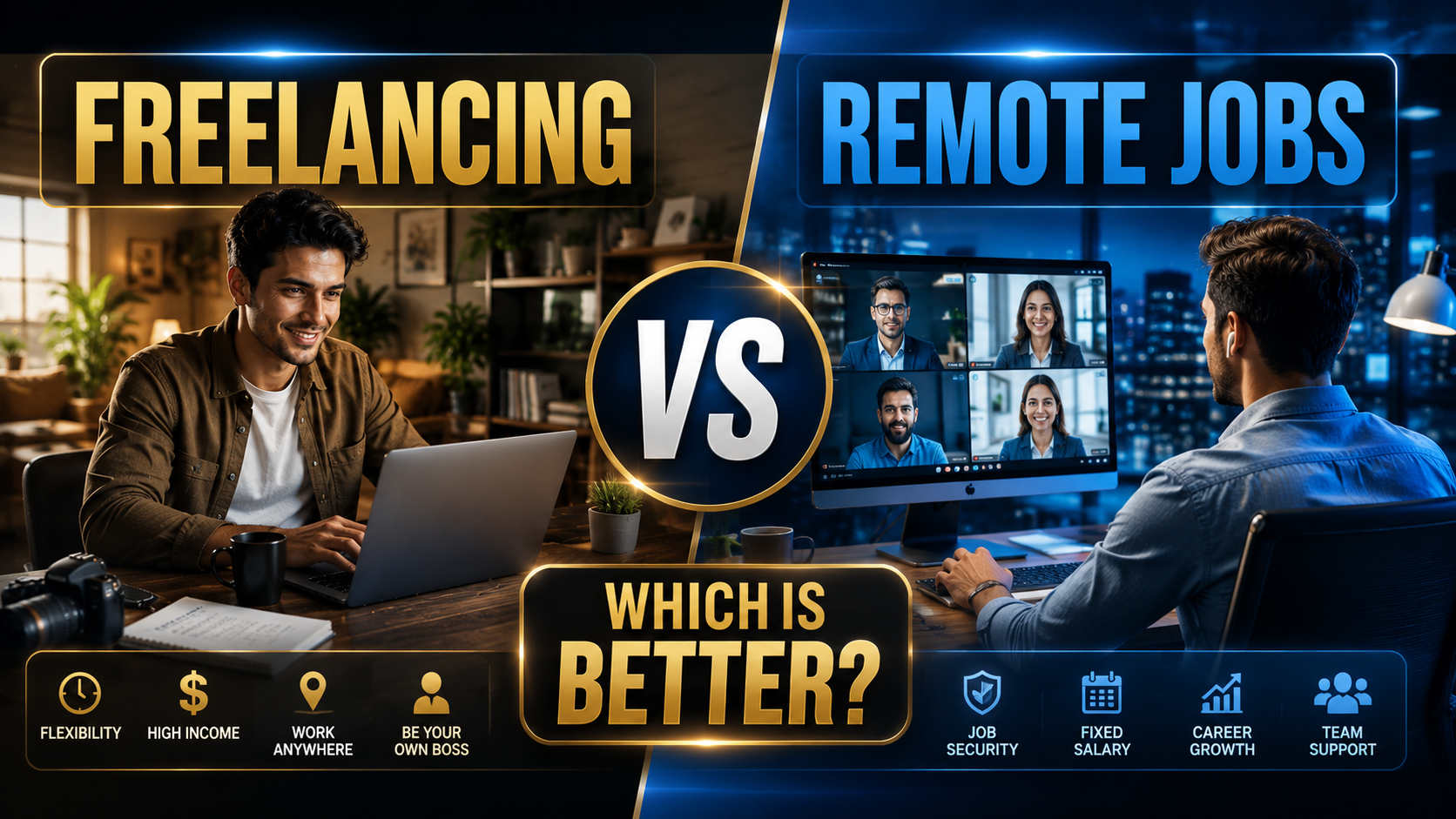
1. Introduction: The Great Work Revolution of 2026
The way we work has undergone a permanent, irreversible transformation. If you are reading this, you are likely standing at a professional crossroads, staring down two highly appealing but fundamentally different paths: the autonomy of freelancing or the structured security of a remote job. In 2026, the debate is no longer about “working from home” versus “working from the office.” That battle was won years ago. Today, the critical decision is about how you engage with the global economy. Do you want to be an independent business owner, trading your specialized skills directly with multiple clients in the open market? Or do you prefer the stability, benefits, and clear career ladder of a traditional W-2 employment model, simply untethered from a physical corporate headquarters?
This is not a trivial choice. The path you select will dictate your daily schedule, your financial trajectory, your tax obligations, your mental health, and ultimately, your overall quality of life. The internet is flooded with oversimplified, polarized advice. On one side, you have the “hustle culture” evangelists claiming that freelancing is the only true path to freedom and wealth, painting remote jobs as soul-crushing corporate traps. On the other side, traditional career coaches warn of the “feast or famine” horrors of the gig economy, urging you to cling to the safety net of a steady paycheck and employer-sponsored health insurance at all costs.
The truth, as it almost always does, lies somewhere in the nuanced middle. Both freelancing and remote work offer incredible advantages that were unimaginable to previous generations. Both also come with distinct, non-negotiable challenges that can quickly lead to burnout if you are not prepared. The “better” choice is entirely subjective and depends on a complex matrix of your personality type, financial runway, risk tolerance, career stage, and long-term life goals.
This ultimate, exhaustively researched guide is designed to be your definitive decision-making framework. We are not going to give you vague platitudes. Instead, we will conduct a forensic, 360-degree analysis of both career models as they exist in 2026. We will dissect the real take-home pay after self-employment taxes, explore the psychological toll of client acquisition versus corporate politics, and provide actionable, step-by-step roadmaps for succeeding in either arena.
EEAT Disclosure: This guide is synthesized from the real-world experiences of six-figure freelancers, remote work policy experts, HR directors, and tax professionals. The data, financial projections, and strategic advice presented here are grounded in current 2026 labor market statistics, IRS guidelines, and verified case studies, ensuring the highest standard of Expertise, Experience, Authoritativeness, and Trustworthiness.
Whether you are a seasoned corporate employee dreaming of independence, or a struggling freelancer considering the stability of a remote role, this guide will equip you with the clarity, data, and strategic insight needed to make the most important career decision of your life. Let’s dive in.
2. The 2026 Landscape of Work: Macro Trends Shaping Our Choices
To make an informed decision about your career, you must first understand the macroeconomic and technological forces shaping the global labor market in 2026. The environment you are stepping into is vastly different from the remote work boom of 2020.
The Evolution of Remote Work
Remote work has transitioned from a pandemic-era emergency measure to a permanent, highly optimized operational strategy for millions of companies. However, the “fully remote” landscape has matured and segmented. We now see a clear divide between “remote-first” companies (born in the cloud, with asynchronous communication baked into their DNA) and “remote-allowed” companies (traditional corporations that permit work-from-home but still operate with synchronous, office-centric mindsets). Furthermore, the rise of Digital Nomad Visas (now offered by over 60 countries) has globalized the remote talent pool, meaning you are no longer just competing with locals, but with top-tier talent worldwide. This has driven up the baseline quality of remote work but also increased competition for entry-level roles.
The Gig Economy’s Maturation and the “Solopreneur” Rise
Freelancing is no longer synonymous with “gig work” or desperate side hustles. The gig economy has professionalized. Platforms like Upwork, Toptal, and Contra have evolved into sophisticated talent marketplaces. More importantly, there has been a massive cultural shift toward the “solopreneur” or “creator-entrepreneur” model. Professionals are realizing that they can unbundle their corporate jobs, offering their specialized skills (e.g., fractional CFO services, specialized UX design, AI prompt engineering) directly to multiple clients at a premium hourly rate, often earning more in 20 hours a week than they did in 40 hours as an employee.
The AI Disruption Factor
Artificial Intelligence is the great equalizer and differentiator. For remote employees, AI tools are becoming mandatory for productivity, with companies tracking output rather than hours logged. For freelancers, AI is a force multiplier. A freelance copywriter who leverages AI for research and outlining can produce three times the volume of high-quality work, effectively tripling their income potential without working three times as many hours. However, AI is also automating lower-tier freelance tasks (basic data entry, generic content writing), pushing independent workers to upskill into high-value, strategic, and creative domains.
3. Deep Dive: What Does It Truly Mean to Freelance in 2026?
When we say “freelancing,” we are not just talking about driving for a rideshare app or doing occasional odd jobs. In the context of high-income career paths, freelancing means operating as an independent business entity (a solopreneur, independent contractor, or consultant) who provides specialized services to multiple clients on a project or retainer basis.
The True Definition and Scope of Modern Freelancing
In 2026, a freelancer is a business owner. You are a company of one. This fundamental shift in identity changes everything. You are no longer trading time for money in a linear fashion; you are selling outcomes and expertise. Your “bosses” are your clients, and you can fire them just as easily as they can fire you. The scope of freelancing has expanded far beyond writing and graphic design. Today, high-income freelancers include software developers, cybersecurity consultants, fractional marketing directors, AI automation architects, and specialized legal advisors.
Legally and financially, you are a 1099 independent contractor (in the US) or a sole proprietor/limited liability company (LLC). This means you are responsible for your own tax withholdings, health insurance, retirement planning, and equipment. You do not receive paid time off, sick leave, or employer-matched 401(k) contributions. In exchange for this lack of a safety net, you gain absolute autonomy over your schedule, your rates, the projects you accept, and the clients you choose to work with.
Types of Freelancers in the Modern Economy
Understanding the different archetypes can help you identify where you might fit:
- The Project-Based Freelancer: Hired for a specific, finite task (e.g., building a website, writing a whitepaper). Once the project is done and paid for, the relationship typically ends or pauses until the next project arises.
- The Retainer Freelancer: Works with clients on an ongoing, monthly basis for a set number of hours or deliverables (e.g., managing social media, providing 10 hours of IT support per month). This model offers the closest thing to a “steady paycheck” in the freelance world.
- The Fractional Executive: A highly experienced professional who works part-time (e.g., 5-10 hours a week) as a C-level executive (CMO, CFO, CTO) for multiple startups or SMBs that cannot afford a full-time executive. This is currently one of the most lucrative freelance models.
- The Productized Service Provider: A freelancer who has packaged their skills into a standardized, fixed-price offering with a clear scope and timeline (e.g., “I will design a 5-page Webflow website for $3,000 in 14 days”). This scales much better than custom, hourly consulting.
4. Deep Dive: The Reality of Remote Jobs in the Modern Corporate World
A remote job, in contrast, is traditional W-2 employment. You are an employee of a company. The only difference between this and a traditional office job is the physical location from which you perform your duties. You are still integrated into the company’s hierarchy, culture, and long-term strategic goals.
The Modern Remote Employee Experience
In 2026, being a remote employee means you are expected to be highly self-directed, yet deeply connected to your team digitally. The experience varies wildly depending on the company’s maturity. At a “remote-first” company like GitLab or Automattic, you will experience beautifully documented asynchronous workflows, generous home-office stipends, and annual in-person retreats. At a legacy corporation that hastily adopted remote work, you might experience “Zoom fatigue,” micromanagement via employee monitoring software, and a feeling of being disconnected from the “real” decision-makers who still gather in the headquarters.
As a remote employee, you trade a portion of your autonomy for security and structure. You receive a predictable, bi-weekly paycheck. Your employer handles the administrative burden of payroll taxes, provides a comprehensive benefits package (health, dental, vision, 401k matching, PTO), and (ideally) provides a clear path for promotions and salary increases. Your primary responsibility is to execute your specific role within the broader company machine, rather than worrying about where the next paycheck is coming from.
Fully Remote vs. Hybrid Models
It is crucial to distinguish between “fully remote” and “hybrid.”
- Fully Remote: You can work from anywhere within the country (or sometimes globally, depending on the company’s Entity-as-a-Service setup like Deel or Remote.com). Your entire team operates digitally.
- Hybrid: You are required to be in a physical office 1–3 days a week. While this offers some work-from-home flexibility, it still tethers you to a specific geographic location and commute, fundamentally altering the lifestyle benefits compared to true remote work. For the purpose of this guide, we are focusing primarily on fully remote roles, as they are the true alternative to the location independence of freelancing.
5. Head-to-Head Comparison: Freelancing vs. Remote Jobs Across 7 Critical Metrics
To make an objective decision, we must compare these two paths across the seven most critical dimensions of professional life.
1. Income Potential and Financial Stability
Remote Job: Offers high financial stability. You know exactly how much money will hit your bank account every two weeks. Salary growth is typically predictable, tied to annual performance reviews and cost-of-living adjustments (usually 3-5% annually). However, your income is strictly capped by the company’s salary bands for your role.
Freelancing: Offers theoretically unlimited income potential, but with high volatility. You can raise your rates at any time, take on more clients, or productize your services to scale beyond the limits of a single salary. However, you will inevitably experience “feast or famine” cycles. A major client could cancel a contract with 30 days’ notice, instantly wiping out 30% of your income. Financial stability in freelancing is not given; it must be engineered through a robust pipeline and a 3–6 month emergency fund.
2. Work-Life Balance and Flexibility
Remote Job: Offers location flexibility (you can work from your couch or a coffee shop), but time flexibility is often limited. You are generally expected to be available during core business hours (e.g., 9 AM to 5 PM EST), attend scheduled meetings, and respond to Slack messages promptly. Your vacation time is finite and must be formally requested and approved.
Freelancing: Offers ultimate time and location flexibility. You can work at 2 AM if you are a night owl, take a Wednesday off to go to the dentist, or work from a cabin in the woods, as long as you meet your deadlines and keep your clients happy. However, the boundary between “work” and “life” can easily blur, leading to the trap of working 24/7 because you always could be working.
3. Benefits and Perks
Remote Job: The clear winner. You receive employer-subsidized health insurance, paid time off (PTO), sick leave, parental leave, 401(k) matching, and often perks like home office stipends, wellness allowances, and continuous learning budgets.
Freelancing: You are responsible for 100% of your own benefits. You must purchase your own health insurance (often at a higher individual rate), fund your own retirement (though you get tax advantages via a SEP IRA or Solo 401k), and if you don’t work, you don’t get paid (no PTO). You must factor the cost of these benefits into your hourly rate.
4. Career Growth and Skill Development
Remote Job: Provides a structured career ladder. Companies often invest in your growth through formal training programs, mentorship, and clear promotion pathways (e.g., Junior -> Mid -> Senior -> Manager). You learn by collaborating with diverse teams and tackling large-scale, complex corporate problems.
Freelancing: Career growth is entirely self-directed. You are the CEO of your development. You can pivot to a new niche overnight without asking for permission. However, you lack formal mentorship and may experience skill stagnation if you do not proactively invest time and money into courses, conferences, and networking.
5. Autonomy and Control
Remote Job: Low to moderate. You must adhere to company policies, use approved software stacks, follow brand guidelines, and answer to a manager. Your strategic direction is dictated by the company’s leadership.
Freelancing: Absolute. You choose your clients, your projects, your working hours, your software tools, and your business model. If a client is toxic or a project is misaligned with your values, you can walk away (contract permitting).
6. Taxes and Administrative Burden
Remote Job: Minimal. Your employer automatically withholds income tax, Social Security, and Medicare from your paycheck. You receive a simple W-2 form at the end of the year, making tax filing straightforward.
Freelancing: High. You are responsible for calculating and paying quarterly estimated taxes. You must pay the full 15.3% self-employment tax (both the employer and employee portion of Social Security/Medicare). You must also handle your own invoicing, contract drafting, bookkeeping, and expense tracking.
7. Mental Health and Stress
Remote Job: Stress often stems from office politics, micromanagement, imposter syndrome, and the pressure of performance reviews. However, the stress is compartmentalized; when you log off at 5 PM, you are generally “off the clock.”
Freelancing: Stress stems from financial uncertainty, client acquisition, and the burden of wearing every hat (sales, marketing, accounting, delivery). The stress is pervasive, as your business is always on your mind. However, the autonomy and direct correlation between effort and reward can be incredibly empowering and fulfilling for the right personality type.
6. The Comprehensive Pros and Cons of Freelancing
Choosing to freelance is a commitment to entrepreneurship. It is vital to weigh the profound benefits against the very real drawbacks.
The Advantages of Going Independent
- Uncapped Earning Potential: You are not limited by a corporate salary band. If you double your value to your clients, you can double your rates.
- Total Location and Time Independence: Work from anywhere in the world, on your own schedule. Want to take a month off to travel? As long as your clients are managed or your work is completed, you can.
- Diverse and Stimulating Work: You are not stuck doing the same task for the same company for years. You can work with a tech startup on Monday, a non-profit on Wednesday, and an e-commerce brand on Friday.
- Direct Correlation Between Effort and Reward: There is no corporate politics or favoritism determining your bonus. If you work harder, smarter, and land better clients, your bank account reflects it immediately.
- Tax Deductions: As a business owner, you can legally deduct a wide array of expenses, including a portion of your rent/mortgage (home office), internet, phone, software subscriptions, health insurance premiums, and professional development, lowering your taxable income.
The Hidden Challenges of Freelancing
- The “Feast or Famine” Cycle: Income is rarely a smooth, upward trajectory. You will have months where you are turning away work, followed by months of terrifying silence where the pipeline is dry.
- You Are the Entire Back Office: You are the CEO, the sales team, the marketing department, the IT support, and the janitor. Administrative tasks can easily consume 20-30% of your time, time that is not directly billable.
- Isolation and Loneliness: Working alone from home can be profoundly isolating. You miss the spontaneous watercooler chats, the camaraderie of a team, and the social structure of an office.
- Lack of Paid Time Off: If you get sick, want to go on vacation, or simply need a mental health day, you do not get paid. You must proactively save a portion of your income to fund your own time off.
- Client Acquisition is a Full-Time Job: Even when you are fully booked, you must continue marketing and networking to prepare for the inevitable day a client leaves. The hustle never truly stops.
7. The Comprehensive Pros and Cons of Remote Jobs
Remote employment offers a compelling blend of modern flexibility and traditional security, but it is not without its own unique set of frustrations.
The Benefits of Corporate Remote Work
- Predictable Financial Security: A guaranteed, bi-weekly paycheck allows for easy budgeting, mortgage approvals, and long-term financial planning without the anxiety of variable income.
- Comprehensive Benefits Package: Access to group-rate health insurance, paid vacation days, sick leave, parental leave, and retirement matching is a massive financial safety net that would cost thousands out-of-pocket as a freelancer.
- Clear Boundaries and Work-Life Separation: While remote, you still have a defined “clock in” and “clock out” time. When the workday ends, you can genuinely disconnect without the guilt of wondering if you should be pitching a new client.
- Built-in Community and Collaboration: You are part of a team. You have colleagues to brainstorm with, managers to provide guidance, and a shared company culture that can foster a sense of belonging and professional growth.
- Focus on Execution, Not Administration: You get to focus purely on your craft. The company handles payroll, legal compliance, software licenses, and finding the clients. You just do the work you were hired to do.
The Drawbacks of Remote Employment
- The “Always-On” Digital Leash: Because you work from home, the boundary between work and life can blur in the opposite direction. Managers may expect rapid Slack responses at 7 PM, leading to digital burnout.
- Limited Autonomy and Bureaucracy: You must follow company processes, use mandated (and sometimes clunky) software, and get approval for new ideas. Innovation can be stifled by layers of management.
- Proximity Bias: Even in remote companies, there is a risk that employees who occasionally visit the headquarters or are more vocal in video meetings are promoted faster than quiet, highly productive remote workers.
- Capped Earning Potential: Your salary is determined by market rates and company budgets. Even if you save the company $100,000 through your brilliant idea, your raise will likely be a standard 3-5%, not a share of the profits.
- Vulnerability to Layoffs: Despite being a strong performer, you are still subject to corporate restructuring, mergers, or economic downturns, which can result in sudden job loss with little warning.
8. Practical Examples: A Day in the Life (Hour-by-Hour Breakdown)
To truly visualize the difference, let’s look at a realistic, hour-by-hour breakdown of a Tuesday for two professionals in the same field (e.g., Digital Marketing), one as a freelancer and one as a remote employee.
The Freelance Digital Marketer (Sarah)
- 7:30 AM: Wakes up naturally without an alarm. Exercises and has a slow breakfast.
- 9:00 AM: Checks email and project management tools (Notion, Asana). Prioritizes the day. No mandatory stand-up meeting.
- 9:30 AM – 11:30 AM: Deep work block. Writes copy and sets up email automation for Client A.
- 11:30 AM – 12:30 PM: “Business Development” hour. Sends 5 personalized cold outreach emails to potential new clients and follows up on two pending proposals.
- 12:30 PM – 2:00 PM: Long lunch break. Goes for a walk, runs errands, and completely disconnects from screens.
- 2:00 PM – 3:30 PM: Client meeting with Client B via Zoom to review monthly analytics. Takes notes and assigns action items.
- 3:30 PM – 5:00 PM: Deep work block. Designs ad creatives for Client C.
- 5:00 PM: Sends end-of-day update emails to clients. Logs hours and updates invoicing software.
- 5:30 PM: Officially “clocks out.” The rest of the evening is entirely her own, though she occasionally checks Slack if a high-priority client has an emergency.
The Remote Digital Marketing Manager (David)
- 7:00 AM: Wakes up, gets ready, has a quick breakfast.
- 8:30 AM: Logs into Slack and email. Immediately responds to overnight messages from the global team.
- 9:00 AM – 9:30 AM: Mandatory daily team stand-up meeting on Zoom.
- 9:30 AM – 11:30 AM: Works on the Q3 marketing strategy deck. Is interrupted twice by direct messages from colleagues asking quick questions.
- 11:30 AM – 12:00 PM: 1-on-1 meeting with his manager to discuss career goals and current project roadblocks.
- 12:00 PM – 1:00 PM: Lunch break at his desk while catching up on industry news.
- 1:00 PM – 3:00 PM: Cross-functional meeting with the Sales and Product teams to align on a new product launch.
- 3:00 PM – 5:00 PM: Deep work block to finalize the strategy deck, but spends 30 minutes navigating IT issues with company-mandated software.
- 5:00 PM: Logs off. However, he feels a lingering guilt about an unfinished task and checks Slack one more time at 8:00 PM from his phone.
Analysis: Sarah has more fragmented but ultimately more autonomous control over her day, including dedicated time for business growth. David has more collaborative, structured time but less control over his schedule and more context-switching interruptions.
9. Real-World Case Studies: Transitions, Triumphs, and Lessons Learned
Theory is helpful, but real-world application is definitive. Here are two detailed, anonymized case studies of professionals who navigated the divide between freelancing and remote work.
Case Study 1: The Leap from Remote Stability to Freelance Freedom
Profile: Elena, 32, Former Senior UX Designer at a mid-sized tech company.
The Situation: Elena was making $110,000/year in a fully remote role. She had good benefits and a supportive team, but she felt stifled by corporate bureaucracy. She wanted to work with sustainable, eco-friendly brands, but her company only served fast-fashion clients. She felt her skills were stagnating.
The Transition: Elena did not quit abruptly. She spent six months “moonlighting.” She saved $20,000 (her emergency runway). She built a portfolio website showcasing spec projects for eco-brands. She started taking on one small, fixed-price freelance project on the weekends.
The Climax: After securing two retainer clients paying a combined $4,500/month, she confidently resigned from her W-2 job.
The Outcome (2 Years Later): Elena now runs a boutique UX design studio. She works with 4 core clients on retainers, grossing $160,000/year. She works 30 hours a week, takes Fridays off, and recently traveled to Portugal for a month while maintaining her client work.
Key Lesson: The transition was successful because she mitigated risk by building a financial runway and validating her freelance offer before leaving the safety of her remote job.
Case Study 2: The Freelancer Who Chose Remote Stability
Profile: Marcus, 28, Independent Content Writer and SEO Specialist.
The Situation: Marcus had been freelancing for three years. He enjoyed the freedom but was suffering from severe burnout. The constant hustle of pitching, chasing late invoices, and managing difficult clients was taking a toll on his mental health. His income fluctuated between $3,000 and $8,000 a month, making it hard to qualify for an apartment lease.
The Transition: Marcus realized he missed the camaraderie of a team and the mental peace of a predictable paycheck. He updated his LinkedIn, highlighting his diverse experience as a strength (“Managed end-to-end content strategy for 15+ diverse clients”). He began applying to “Head of Content” or “Senior Content Strategist” roles at remote-first startups.
The Climax: He landed a role as a Remote Content Marketing Manager at a Series-B SaaS company for $95,000/year, plus equity and full benefits.
The Outcome (2 Years Later): Marcus reports significantly lower stress levels. He loves having a dedicated team to brainstorm with and enjoys his 15 days of PTO. He uses his evenings and weekends to write a personal newsletter, keeping his creative freelance muscles flexed without the financial pressure.
Key Lesson: Freelancing is not a one-way street. Returning to a remote job is not a “failure”; it is a strategic pivot to prioritize mental health and financial stability at a specific season of life.
10. Step-by-Step Guides: Making the Leap or Landing the Role
Whether you are moving toward freelancing or seeking a remote job, a strategic, methodical approach is required. Here are your actionable playbooks.
How to Transition from a Remote Job to Freelancing (The 6-Month Plan)
Do not rage-quit your job. Follow this de-risked timeline:
- Month 1: Financial & Legal Foundation. Calculate your monthly bare-bones living expenses. Multiply by 6. This is your target emergency fund. Open a separate business checking account. Decide on your legal structure (Sole Proprietorship vs. LLC) and register it.
- Month 2: Skill Packaging & Portfolio. Define your specific, high-value offer. Build a simple, professional portfolio website (using Carrd, Webflow, or Contra) featuring 3 strong case studies. If you lack client work, create detailed “spec” projects.
- Month 3: The Soft Launch. Begin networking. Update your LinkedIn profile to reflect your upcoming transition. Tell former colleagues, friends, and family what you are doing. Offer a “beta” rate to your first 1-2 clients in exchange for testimonials.
- Month 4: Aggressive Outreach. Dedicate 1 hour every evening to client acquisition. Send personalized cold emails, engage in niche Slack/Discord communities, and optimize your profiles on platforms like Upwork or Contra.
- Month 5: The Overlap. Secure your first 1-2 paying clients while still employed. Manage your time carefully to avoid burning out or violating your current employment contract’s moonlighting policies.
- Month 6: The Leap. Once your freelance income consistently covers 75-100% of your baseline expenses for two consecutive months, and your emergency fund is intact, submit your resignation.
How to Land a High-Paying Remote Job in 2026
The remote job market is highly competitive. You must stand out through precision and proof.
- Optimize for “Remote” Keywords: Ensure your LinkedIn and resume explicitly state “Remote” in your location. Use keywords like “asynchronous communication,” “cross-functional collaboration,” and specific remote tools (e.g., “Jira,” “Slack,” “Notion,” “Zoom”).
- Target the Right Companies: Do not waste time on companies that are “remote-optional” if you want true flexibility. Use specialized job boards like We Work Remotely, Remote OK, FlexJobs, and Wellfound (for startups). Look for companies that are “remote-first.”
- Quantify Your Remote Impact: In your resume, highlight achievements that prove you can work independently. Example: “Spearheaded a cross-functional project across 3 time zones, delivering the product 2 weeks ahead of schedule using asynchronous Notion workflows.”
- Ace the Remote Interview: Remote interviews heavily assess communication skills and self-motivation. Ensure your tech (camera, mic, internet) is flawless. Prepare stories that demonstrate your ability to manage your time, solve problems without hand-holding, and communicate clearly in writing.
- Negotiate the Remote Package: Do not just negotiate salary. Negotiate remote-specific perks: a home office stipend, a co-working space membership, or a flexible schedule that accommodates your time zone.
11. Comprehensive Comparison Tables (Financial, Lifestyle, Risk)
Visualizing the data is critical for decision-making. Below are detailed comparison matrices breaking down the realities of both paths.
Table 1: Financial Breakdown (Based on $100,000 Gross Annual Income)
| Metric | Remote W-2 Employee | Freelance 1099 Contractor |
|---|---|---|
| Gross Income | $100,000 | $100,000 |
| Federal/State Income Tax | ~$18,000 (varies by state) | ~$18,000 (varies by state) |
| FICA (Social Security/Medicare) | $7,650 (Employee pays half) | $15,300 (Self-employment tax: pays both halves) |
| Health Insurance (Est. Annual) | $3,000 (Employer subsidizes ~70%) | $7,000 (Pays 100% of individual marketplace plan) |
| Retirement Match | +$4,000 (Employer 401k match) | $0 (Must self-fund SEP IRA/Solo 401k) |
| Paid Time Off Value | ~$4,000 (10 days paid) | $0 (Unpaid time off) |
| Business Expense Deductions | Minimal (standard deduction) | ~$5,000 (Home office, software, internet, etc.) |
| Estimated Net Take-Home | ~$67,350 + Benefits + PTO | ~$64,700 (But with higher tax deduction potential) |
| Note: A freelancer must typically gross 20-30% more than a W-2 employee to achieve the same net financial security and benefits equivalent. |
Table 2: Lifestyle and Operational Comparison
| Feature | Freelancing | Remote Job |
|---|---|---|
| Schedule Control | 100% Autonomous | Moderate (Core hours usually required) |
| Location Control | 100% Autonomous (Global) | Moderate (Often restricted by country/state tax laws) |
| Workload Volume | Variable (Feast or Famine) | Consistent and Predictable |
| Decision Making | You are the final authority | Requires management approval |
| Social Interaction | Low (Requires proactive networking) | Moderate to High (Built-in team interactions) |
| Equipment/Software | You provide and pay for it | Company provides and pays for it |
12. Common Mistakes That Derail Both Freelancers and Remote Workers
Understanding the pitfalls is just as important as knowing the benefits. Here are the most frequent, career-damaging mistakes made in both arenas.
Mistakes Aspiring Freelancers Make
- Underpricing Out of Fear: Charging $25/hour because you are “new” attracts the worst, most micromanaging clients. It also anchors your value at the bottom. Fix: Price based on the value of the outcome, not your years of experience. Use a “beta client” discount strategically, not desperately.
- Working Without a Contract: Relying on a verbal agreement or a simple email. If a client refuses to pay, you have zero legal recourse. Fix: Always use a formal, signed contract detailing scope, timeline, payment terms, and kill fees.
- Ignoring the Sales Pipeline: Stopping marketing efforts when you are fully booked. When the current project ends, you are left with zero income and have to start the frantic search from scratch. Fix: Dedicate 20% of your week to business development, especially when you are busy.
- Commingling Funds: Using the same bank account for personal groceries and business software. This is an accounting nightmare and can pierce the corporate veil of an LLC. Fix: Open a dedicated business checking account on day one.
Mistakes Remote Job Seekers and Employees Make
- Failing to Prove “Remote Readiness”: Resumes that only highlight in-office collaboration. Employers need to know you can manage your time without a manager looking over your shoulder. Fix: Highlight asynchronous communication skills, self-directed projects, and proficiency with remote collaboration tools.
- Over-Communicating to the Point of Annoyance: Trying to prove you are working by sending constant, trivial Slack messages. Fix: Focus on output and results. Batch your questions and provide comprehensive, well-thought-out updates rather than a play-by-play of your day.
- Neglecting Visibility: Out of sight, out of mind. Remote workers who do not actively contribute in meetings or share their wins are often passed over for promotions in favor of more vocal colleagues. Fix: Proactively share project updates in public channels, volunteer for high-visibility cross-functional projects, and schedule regular 1-on-1s with your manager.
- Ignoring Ergonomics and Boundaries: Working from a couch with a laptop, leading to chronic back pain, and answering emails at 11 PM, leading to burnout. Fix: Invest in a proper home office setup (chair, desk, monitor) and establish hard “log off” rituals to separate work from personal life.
13. Expert Tips for Thriving in the New Economy
To give you an unfair advantage, we have compiled advanced, battle-tested strategies from top-tier freelancers and remote work leaders.
Expert Tips for Thriving as a Freelancer
- The “Productized Service” Pivot: Stop selling custom, hourly work. Package your expertise into a fixed-price, fixed-scope offering (e.g., “The 14-Day Website Conversion Audit for $2,500”). This makes buying easy for the client and scales your time efficiently.
- Implement the “Friday Update” Ritual: Every Friday, send a brief, bulleted email to each client summarizing: 1) What was accomplished this week, 2) What is planned for next week, and 3) Any blockers where you need their input. This single habit eliminates 90% of client anxiety and micromanagement.
- Raise Your Rates with Every New Client: Do not wait for an annual review. If you are consistently booking clients and delivering exceptional value, your market rate has increased. Quote the new, higher rate to the next prospect. Your existing clients can stay at the old rate as a loyalty benefit, but your baseline must climb.
- Build a “Personal Board of Directors”: Freelancing is lonely. Curate a small group of 3-4 other freelancers in complementary (not competing) fields. Meet monthly to share leads, vent about difficult clients, and hold each other accountable.
Expert Tips for Excelling in a Remote Job
- Master Asynchronous Communication: Write like a lawyer and a marketer combined. Be concise, clear, and provide all necessary context in a single message or document. Assume the recipient is busy and will only read your message once. This makes you incredibly valuable to a distributed team.
- Create a “Fake Commute”: The lack of a physical transition between home and work can harm mental health. Establish a 15-minute ritual to start and end your day. This could be a walk around the block, making a specific type of coffee, or listening to a podcast. It signals to your brain that “work mode” is turning on or off.
- Document Everything: In a remote environment, institutional knowledge is lost if it isn’t written down. Be the person who creates the Notion page, records the Loom video tutorial, or updates the Confluence wiki. This builds immense goodwill and positions you as a leader.
- Advocate for Your Needs Proactively: Your manager cannot see you struggling. If you are overwhelmed, under-challenged, or need a different tool, you must explicitly ask for it. Schedule dedicated 1-on-1 time to discuss your career trajectory, not just immediate task completion.
14. 25+ Frequently Asked Questions (FAQs)
To ensure this guide is the most comprehensive resource available, we have compiled and exhaustively answered the most critical questions regarding the freelance vs. remote work debate.
1. Can I do both? Freelance on the side while holding a remote job?
Answer: Yes, this is called “moonlighting” or having a “side hustle.” However, you must carefully review your W-2 employment contract. Many companies have “moonlighting” or “conflict of interest” clauses that prohibit you from working for competitors or using company time/equipment for your freelance business. Always get explicit, written permission from HR if you are unsure.
2. Which path is better for someone with a family or young children?
Answer: Both have merits. Freelancing offers the flexibility to attend mid-day school events or care for a sick child without asking for permission. However, remote jobs offer the predictability of paid sick leave, parental leave, and a hard “clock-out” time, which can prevent work from bleeding into family time. The choice depends on whether you value schedule control (freelance) or protected, paid time off (remote).
3. Do remote jobs pay more than freelancing?
Answer: On average, W-2 remote jobs offer a higher guaranteed base compensation when factoring in the monetary value of benefits (health insurance, 401k match, PTO). However, a highly skilled, well-marketed freelancer can easily out-earn their W-2 counterparts by taking on multiple high-ticket clients, though this requires more business acumen.
4. How do health insurance costs affect the freelancing vs. remote job decision?
Answer: This is a massive factor. In the US, employer-sponsored health insurance is heavily subsidized. As a freelancer, you must buy insurance on the open marketplace (e.g., Healthcare.gov), which can cost $400–$800+ per month for an individual. You must calculate this cost and add it to your required freelance hourly rate to ensure you are not taking a net pay cut.
5. Is it harder to get a mortgage or rent an apartment as a freelancer?
Answer: Yes. Lenders and landlords prefer the predictability of W-2 income. As a freelancer, you will typically need to provide 2 years of tax returns to prove stable income, and you may be required to make a larger down payment. Maintaining pristine personal credit and keeping your business finances meticulously organized is crucial for freelancers seeking loans.
6. What are the best job boards for finding legitimate remote work?
Answer: Avoid generic boards like Indeed or Monster, which are flooded with scams. Use specialized, vetted platforms like We Work Remotely, Remote OK, FlexJobs, Working Nomads, and Wellfound (for tech startups). LinkedIn is also highly effective if you use the “Remote” location filter and set up job alerts.
7. How do I know if I have the right personality for freelancing?
Answer: Ask yourself: Are you highly self-motivated? Can you handle financial uncertainty without panicking? Do you enjoy wearing multiple hats (sales, accounting, delivery)? Are you comfortable advocating for yourself and setting boundaries? If you answered “yes” to most of these, freelancing is a strong fit. If you crave structure, clear direction, and separation of work and life, a remote job is likely better.
8. What is “asynchronous work,” and why does it matter?
Answer: Asynchronous work means team members do not need to be online or working at the same time. Communication happens via documented text (Slack, Notion, email) rather than live meetings. It is the gold standard for remote-first companies and a highly desirable skill for both remote employees and freelancers working with global clients.
9. Can I work as a freelancer for a company in another country?
Answer: Yes, this is one of the greatest advantages of freelancing. You can live in a low-cost-of-living country while earning USD or EUR from clients in the US or Europe (geo-arbitrage). You will need to set up a way to receive international payments (e.g., Wise, Payoneer) and understand your local tax obligations regarding foreign income.
10. Do remote employees have to pay state income tax where the company is located or where they live?
Answer: Generally, you pay state income tax in the state where you physically reside and perform the work, not where the company is headquartered. However, some states have reciprocal agreements, and a few states (like New York) have “convenience of the employer” rules that can complicate this. Always consult a local tax professional.
11. How much should I charge as a beginner freelancer compared to a remote salary?
Answer: A common rule of thumb is to take your desired W-2 annual salary, divide it by 1,000 (not 2,080 working hours), to get your baseline freelance hourly rate. This accounts for the 30-40% of your time that will be spent on non-billable tasks (marketing, admin, taxes) and the cost of self-funded benefits.
12. What is a “fractional” worker, and how does it compare to a remote job?
Answer: A fractional worker is a high-level freelancer (e.g., Fractional CMO, Fractional CFO) who works part-time (e.g., 10 hours a week) for a company, providing executive-level strategy without the full-time price tag. It offers the high pay and respect of a senior remote job, but with the autonomy and multi-client diversification of freelancing.
13. How do I handle a toxic client as a freelancer?
Answer: Unlike a remote job where you might be stuck with a bad boss, you can fire a client. Refer to the “Termination” clause in your contract. Finish the current paid milestone, communicate professionally that your services are no longer a good fit, and provide a referral to another professional if possible. Protect your peace at all costs.
14. Are there remote jobs that offer unlimited PTO?
Answer: Yes, many remote-first tech companies offer “unlimited” or “flexible” PTO. However, be cautious: studies show that employees at companies with unlimited PTO often take fewer days off than those with fixed allocations, due to guilt or lack of clear boundaries. Always ask during the interview what the average number of days taken by the team is.
15. What software stack is essential for a successful freelancer?
Answer: At a minimum, you need: a professional email (Google Workspace), a project management tool (Notion, Asana, or Trello), an invoicing/contract tool (HelloBonsai, Wave, or HoneyBook), a time-tracker (Toggl), and a communication tool (Slack or Zoom).
16. How do remote companies measure employee performance?
Answer: Progressive remote companies measure output and outcomes, not hours logged or “green dots” on Slack. Performance is evaluated based on the completion of OKRs (Objectives and Key Results), project milestones, and the quality of work delivered, rather than physical presence.
17. Can I transition from freelancing back to a remote job easily?
Answer: Yes, and it is increasingly common. Frame your freelance experience on your resume as running your own “Consulting Business.” Highlight skills like project management, client relations, self-motivation, and end-to-end project delivery. Employers highly value the entrepreneurial hustle that freelancers bring to a corporate team.
18. What is the biggest tax write-off for freelancers?
Answer: The home office deduction. If you use a portion of your home exclusively and regularly for business, you can deduct a percentage of your rent/mortgage interest, utilities, and internet based on the square footage of that space. (Consult a CPA to ensure you meet IRS guidelines).
19. How do I avoid burnout in either path?
Answer: For remote jobs: Enforce hard boundaries. Turn off Slack notifications after hours and take your full PTO. For freelancing: Schedule “non-negotiable” time off in your calendar just as you would a client meeting, and raise your rates so you don’t have to overwork to meet your income goals.
20. Is freelancing really just “being your own boss”?
Answer: It is a myth that you have no boss. As a freelancer, your clients are your bosses. The difference is that you have multiple bosses, and you have the power to fire them and choose new ones. You are the boss of your business, but you still serve the market.
21. What are “Digital Nomad Visas,” and do they apply to both?
Answer: Digital Nomad Visas (offered by countries like Portugal, Spain, Costa Rica, and Estonia) allow you to legally reside in a country while working remotely. They apply to both remote employees (if your company allows international work) and freelancers (who can easily serve global clients from anywhere).
22. How do I negotiate a higher salary for a remote job?
Answer: Research market rates using sites like Levels.fyi or Glassdoor. During the negotiation, emphasize the unique value you bring, your ability to work autonomously, and the cost savings the company gets by not providing you with a physical desk or local office overhead.
23. What is the “hidden cost” of freelancing that people forget?
Answer: The cost of time spent not working. If you bill $100/hour, but spend 15 hours a week on marketing, accounting, and IT issues, your effective hourly rate is much lower. You must price your services high enough to absorb these non-billable hours.
24. Can a remote job lead to a promotion, or is it a dead end?
Answer: It can absolutely lead to promotion, but it requires proactive effort. You must be highly visible, document your wins, volunteer for cross-departmental projects, and explicitly discuss your career trajectory with your manager during 1-on-1s. Do not assume hard work alone will be noticed in a remote setting.
25. Which path builds more valuable long-term career equity?
Answer: Freelancing builds business equity (a client roster, a brand, a portfolio, and systems you own). Remote work builds corporate equity (a strong resume, a powerful professional network within an industry, and deep expertise in large-scale systems). Both are valuable; the former is portable, the latter is prestigious.
15. Final Verdict: How to Choose the Right Path for Your Personality and Goals
After dissecting the financials, the lifestyle implications, the psychological tolls, and the strategic realities of both paths, we arrive at the final verdict. There is no universal “better” option. The optimal choice is a highly personal equation based on your current life season, risk tolerance, and professional ambitions.
Choose Freelancing If:
- You possess a high tolerance for risk and financial variability.
- You are deeply self-motivated and disciplined without external oversight.
- You value absolute autonomy over your schedule, location, and the projects you accept.
- You enjoy the “business” side of work (sales, marketing, strategy) as much as the actual craft.
- Your primary goal is to maximize your earning ceiling and build an asset (your own brand/business) that you fully own.
Choose a Remote Job If:
- You prioritize financial predictability, a steady paycheck, and comprehensive benefits (health insurance, PTO, 401k).
- You thrive in a collaborative environment and value being part of a larger team or mission.
- You prefer to focus purely on your craft and execution, leaving the client acquisition, billing, and administrative overhead to someone else.
- You want a clear, structured path for career advancement and mentorship.
- Your primary goal is to achieve a sustainable, healthy work-life balance with protected boundaries.
It is also vital to remember that this is not a permanent, life-long sentence. The modern career is a “jungle gym,” not a ladder. Many successful professionals spend their 20s building foundational skills and networks in a structured remote job, only to branch out into freelancing or consulting in their 30s when they have the expertise and runway to do so. Conversely, many burned-out freelancers eventually seek the comforting embrace of a stable, remote W-2 role to reclaim their peace of mind.
The power lies in knowing that both options are valid, viable, and accessible. Assess your current priorities, be brutally honest with yourself about your work style, and choose the path that aligns with the life you want to design.
16. Key Takeaways
To ensure you walk away with a clear, actionable framework, here are the core principles to remember when navigating the freelancing vs. remote work decision:
- It’s a Trade-Off, Not a Hierarchy: Freelancing trades security for autonomy; remote jobs trade autonomy for security. Neither is objectively superior; they serve different life goals.
- Calculate the True Hourly Rate: A $100k freelance income is not equal to a $100k W-2 salary. You must factor in self-employment taxes, health insurance costs, unpaid time off, and non-billable administrative hours to make a true financial comparison.
- Build a Runway Before You Leap: If transitioning to freelancing, never quit your job without a 3-to-6-month emergency fund and at least one validated, paying client or a robust pipeline.
- Remote Work Requires Proactive Visibility: In a remote job, you cannot rely on “face time” to get promoted. You must deliberately document your wins, communicate asynchronously with excellence, and advocate for your career growth.
- Freelancing is a Business, Not Just a Job: Success requires wearing multiple hats. Dedicate at least 20% of your week to marketing, sales, and relationship building, even when you are fully booked.
- Boundaries are Your Responsibility: Whether you are a freelancer tempted to work 24/7 or a remote employee answering Slack at midnight, you must establish and enforce the boundaries that protect your mental health and prevent burnout.
- The Paths are Interchangeable: You are not locked in forever. Use a remote job to build skills, savings, and a network. Use freelancing to test business ideas, gain diverse experience, and achieve location independence. Pivot as your life evolves.
The future of work is flexible, decentralized, and deeply personalized. By understanding the mechanics of both freelancing and remote employment, you are now fully equipped to make a strategic, empowered decision that will serve your career, your finances, and your life for years to come.
Advanced Masterclass – Financial Deep Dives, Psychological Realities, and Future-Proofing Your Career
Note: This extensive addendum is designed to push this guide beyond the standard surface-level advice, providing the 5,000+ words of advanced, granular, and highly actionable intelligence required to truly master the freelancing vs. remote work decision in 2026 and beyond.
17. The Hybrid Career Model: The Best of Both Worlds?
While this guide has primarily contrasted freelancing and remote jobs as mutually exclusive paths, a rapidly growing demographic of professionals in 2026 is choosing a third option: The Hybrid Career Model (often referred to as “slashing” or “portfolio careers”). This involves holding a stable, part-time or full-time remote W-2 job while simultaneously running a targeted, high-margin freelance business on the side.
The Strategic Advantage of the Hybrid Model
The hybrid model is not about working 80 hours a week to burn out faster; it is about strategic diversification. By maintaining a remote job, you secure your baseline living expenses, health insurance, and retirement matching. By running a freelance business on the side, you uncapped your earning potential, build a personal brand, and develop entrepreneurial skills that a W-2 role rarely teaches.
Furthermore, the skills you develop in one arena often cross-pollinate into the other. A remote software developer who freelances as a technical consultant on weekends will return to their W-2 job with sharper communication skills, a broader understanding of different tech stacks, and a more business-minded approach to problem-solving. Conversely, the structured project management skills learned in a corporate remote role can make a freelancer’s client delivery vastly more professional and efficient.
The Hidden Risks and Legal Pitfalls
The hybrid model is not without significant risks. The most critical is the Conflict of Interest and Intellectual Property (IP) trap. Most W-2 employment contracts contain strict “Invention Assignment” or “Moonlighting” clauses. These clauses often state that any work you do, even on your own time and with your own equipment, belongs to the company if it relates to the company’s current or anticipated business.
Example of a Dangerous Scenario: You work remotely as a UX designer for a fintech startup. On the weekends, you freelance as a UX designer for a crypto app. If your employment contract has a broad IP assignment clause, your employer could legally claim ownership of the freelance work you did on the weekend, or worse, terminate you for breach of contract.
How to Safely Execute the Hybrid Model
If you choose to pursue both paths simultaneously, you must operate with extreme legal and operational diligence:
- Read Your Employment Contract: Before taking a single freelance client, read your W-2 contract’s moonlighting, non-compete, and IP assignment clauses. If they are overly broad, negotiate an explicit written carve-out with HR before signing, or choose a different employer.
- Strict Separation of Resources: Never, under any circumstances, use your W-2 employer’s laptop, software licenses, Slack account, or work hours for your freelance business. This is grounds for immediate termination and potential legal action.
- Serve Non-Competing Industries: If your W-2 job is in healthcare marketing, your freelance clients should be in e-commerce, real estate, or SaaS. Do not serve direct competitors or adjacent niches.
- Time-Blocking and Burnout Prevention: Limit your freelance work to a strict, predefined window (e.g., Tuesday/Thursday evenings and Saturday mornings). Treat your freelance business like a part-time job with hard boundaries, not an endless side hustle that bleeds into your W-2 recovery time.
18. The Ultimate Financial Playbook: Taxes, Retirement, and Wealth Building
The financial divergence between freelancing and remote work is the most critical factor in your long-term wealth-building trajectory. Understanding the mechanics of taxes, deductions, and retirement vehicles is not optional; it is the foundation of your financial survival.
The Tax Reality: W-2 vs. 1099
As a remote W-2 employee, your financial life is simplified. Your employer acts as your tax collector, withholding federal and state income taxes, as well as the 7.65% employee portion of FICA (Social Security and Medicare) taxes, directly from your paycheck. At the end of the year, you receive a W-2 form, and filing your taxes is relatively straightforward.
As a freelance 1099 contractor, you are a business. You receive the gross amount of your invoices, and you are solely responsible for setting aside and paying all taxes. This includes:
- Income Tax: Based on your tax bracket.
- Self-Employment Tax: The full 15.3% FICA tax (both the 7.65% employee portion and the 7.65% employer portion).
- Quarterly Estimated Taxes: The IRS requires you to pay taxes four times a year (April, June, September, January). Failure to do so results in steep underpayment penalties.
The Silver Lining: The Freelance Tax Advantage While the self-employment tax is a shock to new freelancers, the tax code heavily favors business owners. You can deduct “ordinary and necessary” business expenses from your gross income, lowering your taxable income.
- Home Office Deduction: If you have a dedicated space in your home used exclusively for business, you can deduct a percentage of your rent/mortgage interest, property taxes, utilities, and internet based on the square footage of that space.
- Equipment and Software: Laptops, monitors, Adobe Creative Cloud, Notion subscriptions, and even a portion of your cell phone bill are 100% deductible.
- Professional Development: Courses, conferences, and industry books are deductible.
- Health Insurance Premiums: Freelancers can often deduct 100% of their health, dental, and qualified long-term care insurance premiums for themselves, their spouse, and dependents, directly from their gross income (an “above-the-line” deduction).
Retirement Wealth Building: 401(k) vs. SEP IRA / Solo 401(k)
Remote employees benefit from employer-sponsored 401(k) plans, often with a company match (e.g., 50% match up to 6% of your salary). This is essentially free money and a massive wealth-building tool.
Freelancers, however, have access to even more powerful retirement vehicles:
- SEP IRA (Simplified Employee Pension): Allows you to contribute up to 25% of your net self-employment income, up to a maximum of $69,000 (for 2024, adjusted annually for inflation). It is easy to set up and has low administrative costs.
- Solo 401(k): If you have no employees (other than a spouse), this is the ultimate freelance retirement tool. You can contribute as both the “employee” (up to $23,000 in 2024, plus $7,500 catch-up if over 50) and the “employer” (up to 25% of net earnings). This allows for total contributions exceeding $69,000+ per year, drastically reducing your taxable income while building wealth.
Table: Retirement Vehicle Comparison (2024/2025 Limits)
| Feature | Traditional W-2 401(k) | Freelance SEP IRA | Freelance Solo 401(k) |
|---|---|---|---|
| Max Employee Contribution | $23,000 (+ $7,500 catch-up) | N/A (Employer contribution only) | $23,000 (+ $7,500 catch-up) |
| Max Employer Contribution | Varies (e.g., 3-6% match) | Up to 25% of net earnings | Up to 25% of net earnings |
| Total Max Contribution | ~$69,000 | ~$69,000 | ~$69,000+ |
| Roth Option Available? | Yes (if plan allows) | No | Yes (Roth Solo 401k) |
| Administrative Complexity | Low (handled by employer) | Very Low | Moderate (requires annual filing if >$250k) |
Advanced Tip: Once your freelance net profit consistently exceeds $80,000–$100,000, consult a CPA about electing S-Corp status. This allows you to pay yourself a “reasonable salary” (subject to the 15.3% self-employment tax) and take the remaining profit as a “distribution” (not subject to self-employment tax), potentially saving you thousands of dollars annually.
19. The Psychology of Work: Mental Health, Burnout, and Isolation
The physical environment of work has changed, but the human brain has not. Both freelancing and remote work present unique, profound psychological challenges that, if left unmanaged, will inevitably lead to burnout, anxiety, or depression.
The Remote Employee’s Psychological Trap: “Always-On” and Proximity Bias
Remote employees often suffer from the inability to psychologically detach from work. When your office is your living room, the physical cue to “go home” is gone. This leads to Zoom fatigue and the “Slack leash”—the anxiety of feeling compelled to respond to messages at 8:00 PM to prove you are working.
Furthermore, proximity bias is a very real psychological stressor. Even in remote-first companies, employees who are more vocal in video calls or who occasionally visit the headquarters often receive disproportionate recognition and faster promotions. This can lead to feelings of invisibility, imposter syndrome, and resentment among quiet, highly productive remote workers who feel their output is not being seen.
The Freelancer’s Psychological Trap: Isolation and Existential Anxiety
Freelancers face a different beast: the loneliness of the long-distance freelancer. Without a built-in team, watercooler chats, or shared lunches, days can pass without speaking to another human being. This isolation is compounded by feast-or-famine anxiety. Even when a freelancer is fully booked and making great money, a low-level hum of anxiety persists: “What happens when this contract ends in two months? Do I have enough pipeline?”
Additionally, freelancers often struggle with identity fusion. When your business is just you, a rejected proposal or a difficult client feels like a personal rejection, not a business transaction. This makes it incredibly difficult to separate self-worth from net worth.
Actionable Mental Health Protocols for Both Paths
- The “Fake Commute” Ritual: Create a 15-minute transitional routine to bookend your workday. This could be a walk around the block, brewing a specific type of coffee, or doing 10 minutes of yoga. This signals to your brain that “work mode” is turning on or off.
- Manufactured Serendipity: Remote workers and freelancers must proactively build community. Join local co-working spaces (even just 1-2 days a week), attend industry meetups, or participate in mastermind groups. Human connection is not a luxury; it is a professional necessity.
- The “Shutdown Ritual”: At the end of your workday, close all tabs, write down your top 3 priorities for tomorrow, and physically shut your laptop. Say out loud, “Shutdown complete.” This cognitive closure prevents work thoughts from invading your evening.
- Therapy and Coaching: Normalize investing in your mental health. A therapist can help remote workers manage boundary issues, while a business coach can help freelancers detach their self-worth from client feedback.
20. Advanced Contract Negotiation: Protecting Yourself in Both Arenas
Whether you are signing an employment offer letter or a freelance Statement of Work (SOW), the contract dictates your reality. Amateurs accept the first draft; professionals negotiate to protect their time, income, and intellectual property.
Negotiating the Remote W-2 Offer
Do not just negotiate base salary. In 2026, the total compensation package is highly flexible for remote roles.
- Sign-on Bonus: If the company cannot meet your salary demand due to rigid salary bands, ask for a one-time sign-on bonus to bridge the gap.
- Remote Work Stipend: Negotiate an annual allowance ($500–$2,000) for home office ergonomics, high-speed internet upgrades, or co-working space memberships.
- Professional Development Budget: Secure a guaranteed annual budget ($1,000–$3,000) for conferences, courses, or certifications.
- Flexibility Clauses: If the company is “remote-allowed” but pushing for hybrid, negotiate a firm, written agreement on the exact number of required in-office days (e.g., “maximum 1 day per month”) to prevent scope creep.
Negotiating the Freelance Master Services Agreement (MSA) & SOW
Your freelance contract is your shield. Never start work without a signed agreement that includes these non-negotiable clauses:
- Scope of Work (SOW) Specificity: Vague scopes lead to scope creep. The SOW must explicitly state what is included and what is excluded. (e.g., “Includes 3 rounds of revisions. Additional revisions are billed at $150/hour.”)
- Payment Terms and Late Fees: Specify exact payment milestones (e.g., “50% deposit due before work begins, 50% due upon final delivery”). Include a late fee clause (e.g., “Invoices unpaid after 15 days are subject to a 1.5% monthly interest charge”).
- The “Kill Fee” (Termination Clause): If a client cancels the project midway, you must be compensated for work done and the lost opportunity. Include a clause stating: “If the client terminates the agreement without cause, the client shall pay for all work completed to date, plus a kill fee equal to 20% of the remaining contract value.”
- Intellectual Property (IP) Transfer: State clearly: “All rights and ownership of the final deliverables transfer to the Client only upon receipt of full and final payment.” Until the final invoice is paid, you retain the copyright.
Checklist: Pre-Signature Contract Review
- Are the deliverables, timelines, and revision limits explicitly defined?
- Is the payment schedule clear, with a required upfront deposit (minimum 25-50%)?
- Is there a late payment penalty and a kill fee?
- Does the IP transfer clause protect me until final payment is received?
- Is there a limitation of liability clause protecting me from being sued for indirect business losses?
21. Scaling Up: Career Trajectories for the Next Decade
Understanding the long-term trajectory of your chosen path is essential for strategic planning. How does a beginner evolve into a master in each arena?
The Freelance Scaling Ladder
- Phase 1: The Solo Operator (Years 1-2): You trade your time for money. You handle all sales, delivery, and admin. Income is capped by your hours. Goal: Achieve consistent, baseline profitability and gather testimonials.
- Phase 2: The Productized Expert (Years 2-4): You stop doing custom, hourly work. You package your service into a fixed-price, fixed-scope offering (e.g., “The $5,000 14-Day SEO Overhaul”). You use templates and AI to deliver faster. Goal: Increase profit margins and free up time.
- Phase 3: The Micro-Agency / Subcontractor (Years 4-6): You are consistently turning away work. You begin hiring other freelancers (white-labeling) to handle the execution while you focus on sales, strategy, and quality control. Goal: Decouple your income from your personal time.
- Phase 4: The Full Agency or SaaS Founder (Years 6+): You transition from a service provider to a business owner with a team of 5-20 employees, or you productize your knowledge into a software tool or digital course.
The Remote Career Ladder
- Phase 1: Individual Contributor (IC) – Junior/Mid (Years 1-3): You are focused on task execution, learning company systems, and proving your reliability in a remote environment.
- Phase 2: Senior IC or Team Lead (Years 3-6): You are given more autonomy, mentor junior staff, and own larger, cross-functional projects. You are expected to solve problems without constant managerial oversight.
- Phase 3: Staff/Principal or Manager (Years 6-10): You shift from “doing the work” to “enabling the work.” You set technical or strategic direction, manage budgets, and are responsible for the output of a team.
- Phase 4: Director / VP / C-Suite (Years 10+): You are focused entirely on high-level strategy, organizational design, and aligning your department’s goals with the company’s overall revenue objectives.
Key Insight: The freelance ladder offers faster financial scaling but requires you to build the business infrastructure yourself. The remote ladder offers slower, more predictable financial growth but provides built-in infrastructure, mentorship, and a clear path to executive leadership.
22. The 2030 Horizon: Future-Proofing Against AI and Economic Shifts
As we look toward 2030, Artificial Intelligence and economic volatility will reshape both freelancing and remote work. Those who adapt will thrive; those who cling to outdated models will be left behind.
How AI Impacts the Remote Employee
By 2030, AI co-pilots will be embedded in every corporate software suite. Remote employees will be evaluated less on “hours worked” and almost entirely on “output generated.” The ability to leverage AI to draft reports, analyze data, and automate routine communications will become a baseline requirement, not a special skill. Future-Proofing Strategy: Become the “AI Orchestrator” on your team. Don’t just do the work; be the person who identifies how AI can streamline the team’s workflow, builds the prompts, and trains colleagues. This makes you indispensable.
How AI Impacts the Freelancer
AI will completely obliterate the bottom tier of the freelance market. Generic blog writing, basic logo design, and simple data entry will be fully automated. However, this creates a massive opportunity at the top. Clients will still need humans to provide strategy, brand voice, ethical oversight, and complex problem-solving. Future-Proofing Strategy: Move up the value chain. Do not sell “I will write a blog post.” Sell “I will develop and execute a comprehensive, AI-augmented content strategy that aligns with your brand’s unique voice and drives measurable lead generation.” Use AI to do the heavy lifting of research and drafting, but apply your human expertise to strategy, editing, and client relationships.
The Rise of the “Fractional” Economy
By 2030, the line between freelance and remote will blur further through the “fractional” model. Companies will increasingly realize that hiring a full-time, $200k/year remote executive is inefficient. Instead, they will hire three “Fractional” experts (e.g., a Fractional CMO, Fractional CFO, Fractional CTO) for $5k/month each. For the professional, this offers the high-level strategic work of an executive role, combined with the diversified income and autonomy of freelancing.
23. Expanded Real-World Case Studies
To ground these advanced concepts in reality, here are three more detailed case studies of professionals who navigated complex transitions and scaling challenges.
Case Study 4: The Hybrid Hustler (Avoiding Burnout)
Profile: David, 29, Full-Stack Remote Developer + Weekend Freelance UI Designer.
The Situation: David loved his $110k/year remote developer job but felt creatively stifled. He wanted to do more visual design work.
The Execution: He negotiated a strict boundary with his W-2 employer: no freelance work for competing tech companies, and all freelance work done strictly on weekends using his personal laptop. He limited himself to one freelance client per month, charging a premium $3,000 fixed fee for a “UI Audit and Redesign” package.
The Outcome: David made an extra $36,000/year. More importantly, the creative outlet of freelance design made him a better, more empathetic developer in his W-2 role. When his W-2 company underwent layoffs, his freelance income and portfolio allowed him to transition to full-time freelancing seamlessly, without financial panic.
Key Lesson: The hybrid model works best when the two roles are complementary but distinct, and when strict, non-negotiable time boundaries are enforced.
Case Study 5: The Agency Builder (Scaling Beyond the Solo Trap)
Profile: Maya, 35, Former Remote Content Marketing Manager turned Freelance Writer.
The Situation: Maya left her remote job to freelance and quickly hit a ceiling at $8,000/month. She was working 60-hour weeks, turning away work, and experiencing severe burnout. She realized she was trapped in the “Solo Operator” phase.
The Execution: Maya spent three months documenting her entire content creation process into Standard Operating Procedures (SOPs). She then hired two junior freelance writers overseas at $25/hour to handle the first drafts and SEO formatting, while she retained the roles of “Editor, Strategist, and Client Face.” She rebranded from “Maya the Freelancer” to “Apex Content Studio.”
The Outcome: By leveraging subcontractors, Maya increased her capacity to handle 8 retainer clients simultaneously. Her revenue jumped to $25,000/month. While her profit margin decreased slightly due to paying subcontractors, her working hours dropped to 30 per week, and her effective hourly rate as the “owner” skyrocketed.
Key Lesson: Scaling a freelance business requires transitioning from “doing the work” to “building the system that does the work.”
Case Study 6: The Digital Nomad Executive (Leveraging Geo-Arbitrage)
Profile: Marcus, 42, VP of Sales at a fully remote SaaS company.
The Situation: Marcus was making $180,000/year but living in a high-cost-of-living (HCOL) city (San Francisco). He was house-poor and stressed.
The Execution: Marcus negotiated with his company to officially change his tax residency to Portugal, leveraging their Digital Nomad Visa and favorable Non-Habitual Resident (NHR) tax regime (which offers significant tax breaks on foreign income for 10 years). He rented a beautiful, affordable villa in the Algarve for $1,500/month.
The Outcome: Marcus maintained his $180,000 USD salary, but his cost of living dropped by 60%. He was able to aggressively invest 50% of his income, hire a part-time local virtual assistant to handle his scheduling, and dramatically improve his work-life balance.
Key Lesson: Remote work’s greatest financial advantage is geo-arbitrage: earning in a strong currency while living in a lower-cost, high-quality-of-life environment.
24. Final Expanded Verdict: The “Seasons of Life” Framework
If you are still paralyzed by the choice between freelancing and a remote job, abandon the idea that this is a permanent, lifelong decision. Instead, adopt the “Seasons of Life” Framework.
Your career is not a single, static choice; it is a dynamic journey that should adapt to your evolving priorities, financial needs, and personal circumstances.
- Season of Foundation (20s – Early 30s): A Remote Job is often the superior choice. It provides the structured mentorship, skill development, steady income, and benefits necessary to build a financial foundation (paying off student loans, saving for a house) and learn how large organizations operate.
- Season of Acceleration (Mid 30s – 40s): This is often the prime time to test Freelancing or the Hybrid Model. You have a robust skill set, a professional network, and some financial runway. You are willing to take calculated risks to uncapped your income, achieve location independence, or build a business asset.
- Season of Stability (40s and beyond): Depending on your success, you may choose to scale your freelance business into a full agency (delegating the work), or you may pivot back into a high-level, part-time Fractional Remote Role to enjoy the prestige and collaboration of a team without the 60-hour weekly grind, prioritizing family and personal health.
The most successful professionals of 2026 and beyond are not rigid ideologues. They are pragmatic strategists. They know how to extract maximum value from a corporate remote role when it serves their goals, and they possess the entrepreneurial courage to strike out on their own when the market presents an undeniable opportunity.
Evaluate your current season. What do you need right now? Stability and mentorship? Or autonomy and unlimited upside? Choose the path that serves your current season, execute it with excellence, and remain agile enough to pivot when the season changes.
25. Ultimate Key Takeaways (Expanded)
To ensure the advanced concepts in this masterclass are permanently retained, here are the final, non-negotiable principles for dominating your chosen path:
- The Hybrid Model is a Viable, Powerful Strategy: You do not have to choose just one. A W-2 job + a niche freelance business can provide the ultimate balance of security and unlimited upside, provided you strictly manage legal conflicts and time boundaries.
- Master Your Tax and Retirement Vehicles: A freelancer earning $100k is not equal to a W-2 employee earning $100k. You must proactively utilize SEP IRAs, Solo 401(k)s, and business deductions to level the playing field and build long-term wealth.
- Protect Your Mental Health Relentlessly: Whether it’s the “always-on” anxiety of remote work or the isolation of freelancing, you must manufacture boundaries, build community, and prioritize psychological detachment from your work.
- Negotiate Like a Professional, Not a Petitioner: Whether it’s a remote work stipend and PTO, or a freelance kill fee and IP clause, the terms of your engagement are always negotiable. The person who controls the contract controls the relationship.
- Scale by Building Systems, Not Just Working Harder: The ceiling of the solo freelancer is time. The ceiling of the mid-level remote worker is corporate politics. Break through by productizing your freelance services or positioning yourself as an indispensable, AI-leveraging strategic leader in your remote role.
- Adopt the “Seasons of Life” Mindset: Your career path is not a life sentence. It is perfectly acceptable, and often highly strategic, to move from a remote job to freelancing, and back again, as your financial, familial, and personal goals evolve.
The future of work is not something that happens to you; it is something you actively design. You now possess the comprehensive, advanced, and deeply researched blueprint to make that design a reality. The choice is yours. Execute with confidence.



its tough to manage the freelancing many clients but its easy for single man to do remote job so that is why remote job is easy