








Short answer: yes, directly. P11D value salary sacrifice take home pay are all connected by one simple formula, and the higher the P11D value, the more tax you pay on the car.
Here’s the mechanic behind that, with real numbers so you can check your own deal.
What is a car’s P11D value?
The P11D value is the list price of the car, including VAT, delivery, and any factory-fitted extras. It excludes the first registration fee and the annual road tax.
HMRC uses this figure, not the price you’d actually pay after any discount, as the base number for calculating tax on a company car. You’ll find it on the manufacturer’s quote or your leasing company’s paperwork, usually labelled exactly as “P11D value.”
What is salary sacrifice for a company car?
You give up part of your gross salary in exchange for a car provided by your employer. That sacrificed amount comes off your salary before tax and National Insurance, which is where the savings usually come from.
In return, you’re taxed on the car itself as a Benefit in Kind (BIK). That tax is where P11D value comes back into the picture.
How P11D value affects salary sacrifice take-home pay
Understanding P11D value salary sacrifice take home pay math starts with one formula:
Taxable benefit = P11D value × BIK rate (%)
Tax owed = Taxable benefit × your income tax rate
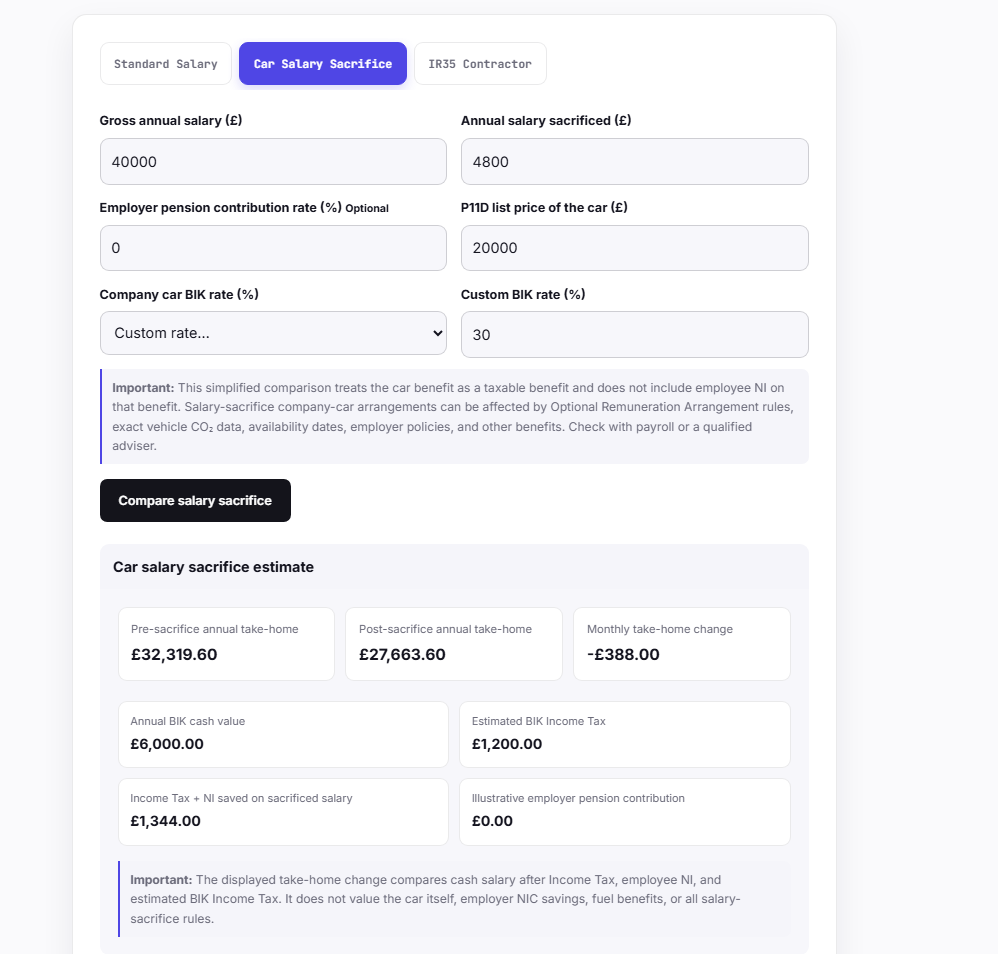
The BIK rate depends on the car’s CO2 emissions (or electric range for hybrids and EVs) and changes most tax years, so always check the current HMRC rate before you commit to a deal. For this example, we’ll use an illustrative rate of 30%, a rough midpoint for an average petrol car.
Worked example: two cars, same salary sacrifice
Say you sacrifice $400 a month gross salary either way. Here’s how two cars with different P11D values compare, assuming a basic-rate taxpayer at 20% income tax:
Car A: P11D value £20,000
- Taxable benefit: £20,000 × 30% = £6,000
- Annual tax owed: £6,000 × 20% = £1,200
- Monthly cost of the benefit: £100
Car B: P11D value £30,000
- Taxable benefit: £30,000 × 30% = £9,000
- Annual tax owed: £9,000 × 20% = £1,800
- Monthly cost of the benefit: £150
Same salary sacrifice, same tax band, same BIK rate. The only thing that changed is the P11D value, and it added £50 a month to your tax bill. That’s £50 less in your pocket every single month, purely because the car costs more on paper.
For a higher-rate taxpayer at 40%, that gap doubles: £200 versus £300 a month, a £100 difference driven entirely by P11D value.
Why electric and hybrid cars change the math
Fully electric cars sit on a much lower BIK band, often single digits, compared to 25-37% for higher-emission petrol and diesel cars. A £40,000 EV can end up costing less in monthly BIK tax than a £20,000 petrol car with a high emissions rating.
So P11D value never tells the whole story on its own. It’s P11D value multiplied by the BIK rate that actually determines your take-home pay hit, and the rate swings enormously by fuel type and emissions.
Common mistakes people make with this calculation
Comparing P11D values without checking the BIK rate. A cheaper car with a high BIK band can cost more in tax than a pricier low-emission one.
Forgetting the rate changes yearly. HMRC updates BIK bands most tax years, sometimes significantly for hybrids and EVs. Don’t reuse last year’s number.
Ignoring National Insurance on the sacrificed portion. Your salary sacrifice savings usually include NI, not just income tax, which changes the real net benefit.
Assuming the dealer’s price is the P11D value. It isn’t, if you negotiated a discount. HMRC still uses the full list price.
Check your own numbers
The math above is straightforward, but plugging in your actual salary, tax band, and the specific P11D value on your quote takes a few tries by hand. If you want to see your own P11D value salary sacrifice take home pay numbers instantly, our UK tax calculator runs entirely in your browser and helps you check the real take-home impact before you sign anything.
For the official current-year BIK rates and P11D rules, check HMRC’s company car tax guidance directly, since the bands do shift.
FAQ
Does a lower P11D value always mean lower tax? Only if the BIK rate stays the same. A low P11D value on a high-emissions car can still cost more in tax than a higher P11D value on a low-emissions one.
Is P11D value the same as the car’s market value? No. It’s the list price set by the manufacturer, not what the car is worth secondhand or what you’d pay after a discount.
Does salary sacrifice always save money regardless of P11D value? Not automatically. If the P11D value and BIK rate combine to create a large taxable benefit, the tax can eat into most of the salary sacrifice benefit, especially for higher-rate taxpayers.
Where do I find my car’s exact P11D value? Ask your leasing company or dealer for it directly. It should also appear on your employer’s benefit statement once the car is set up under salary sacrifice.
Do I pay National Insurance on the BIK amount myself? Generally no. Your employer pays Class 1A National Insurance on the benefit. You pay income tax on it through your tax code, which is what reduces your take-home pay.